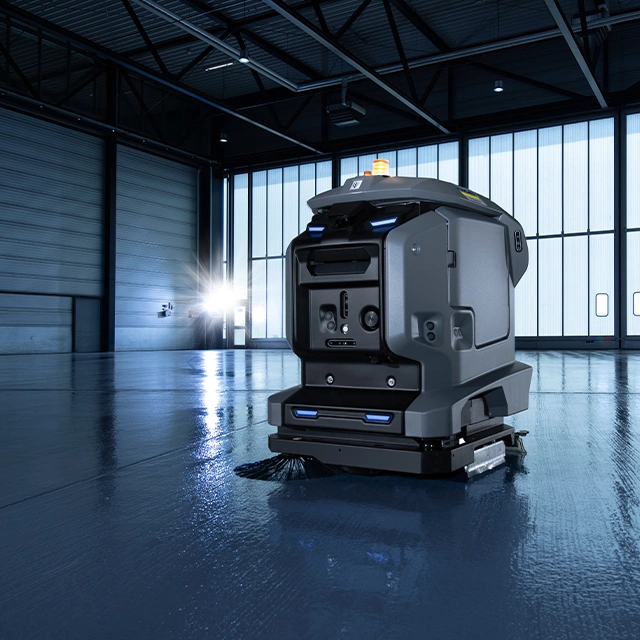


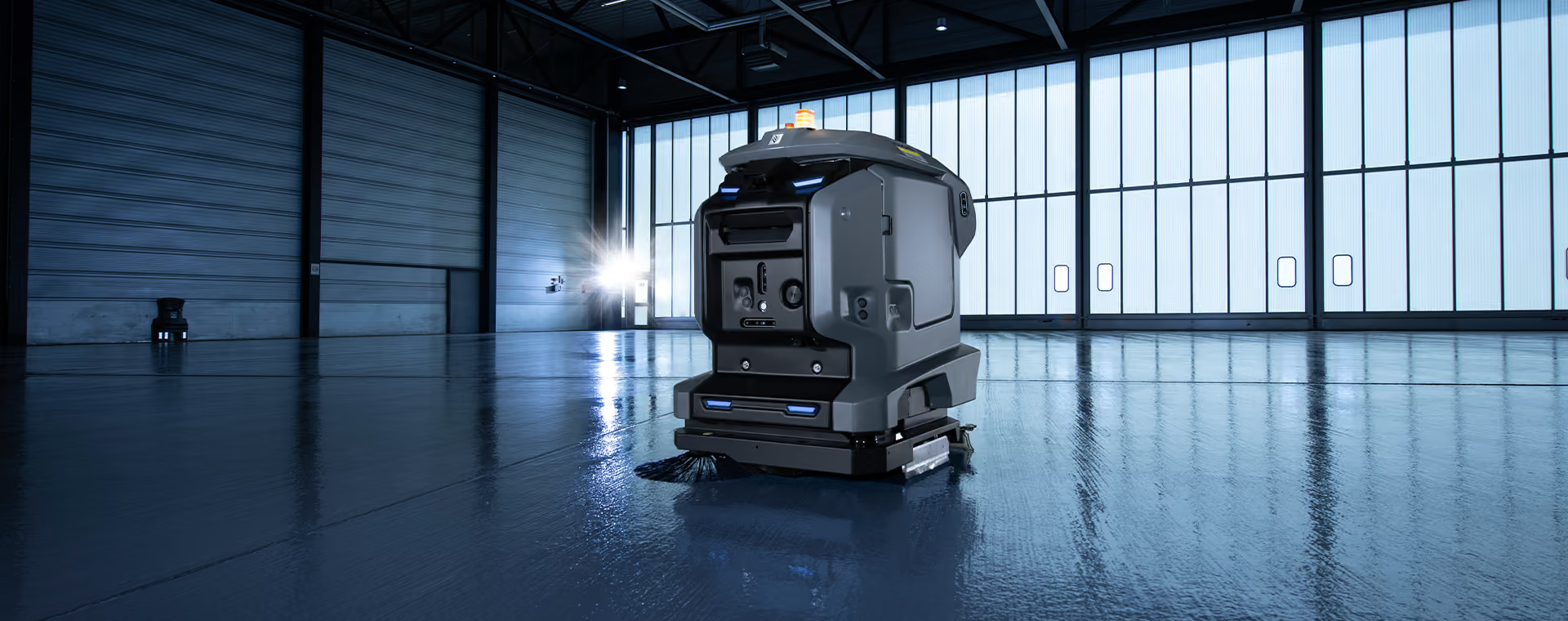


Kärcher adopted connected devices early on: Back in 2013, “Kärcher Fleet” established a cloud solution on AWS to centrally analyze telemetry data such as location, battery status, and utilization. Building on this foundation, Kärcher developed the KIRA B 50 – an innovative cleaning robot that autonomously handles floor cleaning in commercial buildings.
For KIRA, Kärcher and Zoi expanded this data flow significantly: The cellular connection feeds operational data into the customer dashboard while simultaneously deploying new software updates for the operating system, navigation, and sensors directly to the machine.
To deliver both radiant cleaning results and maximum value for customers, three IT-related requirements were needed and with the help of Zoi they were realised:
1. REGULAR UPDATES
Create a way to connect the cleaning robot to the AWS cloud via cellular connection to update the software when needed. The needed updates relate to the operating system, applications and peripheral components such as sensors.
2. SMART COMMUNICATIONS
IIntegrate a communication interface into the cleaning robot to enable both end customers and Kärcher service technicians to monitor the operating status.
For this, telemetry data had to be transmitted so that end customers could monitor and configure the settings of the cleaning robot in a browser-based dashboard in the cloud backend.
Trained service technicians should also be given extended access to perform maintenance on the machine, view log files and thus optimally plan any necessary service calls.
3. TECHNICIAN ACCESS WITHOUT CELLULAR NETWORK
Establish a direct connection between the service technician's laptop and the cleaning robot, since the robot is also used in environments in which a mobile phone connection to the cloud infrastructure could be weak or non-existent. Servicing the cleaning robot had to be guaranteed independently of a mobile phone connection.
HOW THE KIRA B 50 CONNECTS TO THE AWS CLOUD
Zoi has developed a software gateway so that the Kira B 50 cleaning robot can communicate seamlessly with the Kärcher Cloud, which is based on the AWS Cloud, and with the software of the service technician. There are two ways to establish a data connection to the machine to ensure connectivity:
– The first connection option provides a secure data connection over the public cellular network to AWS IoT Core. This means that both the customer and service technician can easily communicate with the cleaning robot.
– The second data connection is established via a WLAN router installed in the robot which connects to the service technician's notebook.
To ensure the robot is always up to date, a CI/CD pipeline was built. Software packages were created for all applications, which are transferred to the robots via an update process.
In the first step of the implementation, we developed a software gateway to access the process image of the cleaning robot. The gateway is implemented as an independent component within the robot's operating system. The gateway can retrieve information from other applications - such as navigation – via an intercommunication functionality in the operating system and make it available to the AWS backend for further processing.
However, there are also system components in the cleaning robot that are not accessible via the intercommunication functionality of the operating system – such as a CANopen bus system and a local database for storing configurations. In order to access these system components, we have integrated appropriate interfaces into the software gateway.
Once this implementation has been completed, the gateway is able to communicate with all the necessary system components.
.svg)
Then focus was placed on the data connection between the gateway and the outside world. This required the creation of interfaces for service technicians and AWS integration. We have therefore added two interfaces to the gateway: the AWS Endpoint, which enables a connection to AWS, and the Service Endpoint, which gives service technicians access to the robot.
.svg)
The AWS service IoT Core was selected as the AWS endpoint for the transmission of telemetry data from all cleaning robots. This means that all system states can be transmitted to the IT backend in the AWS cloud using MQTT messages.
To give the service technicians access to the cleaning robot, even if there is no mobile data connection, a WLAN access point can be opened inside the machine. The service technician uses his laptop to connect directly to the machine via this access point.
In order to use the synergy effects of the already existing data connection between the cleaning robot and the AWS infrastructure, the AWS infrastructure – consisting of IoT Core and IoT Jobs – was simulated within the service software, which is installed on the service technician's PC.
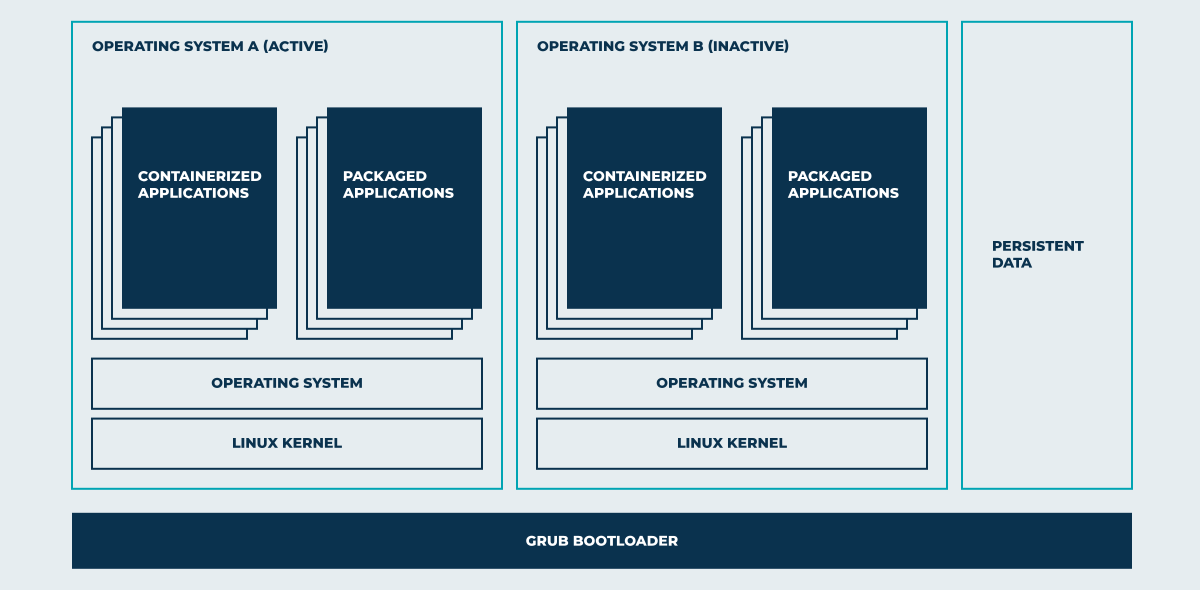
It is important to ensure IoT devices can be monitored and updated in the field for years to come. For this, we have created an automated build process for the entire operating system including all applications. The reproducible image created in this way can be automatically played out on the machines.
In detail, two partitions are formed within the autonomous cleaning robot. The operating system that is currently being used is located in a partition. The new operating system image is imported into a second, inactive partition. After a successful update, the Kira B 50 restarts, and the GRUB bootloader selects the new image. If the system starts incorrectly due to a defective update, the autonomous cleaning robot rolls back to the last working operating system.
At Kärcher, a 17,000-strong team in 82 countries and 160 companies work together to make the world a little cleaner. As the market leader in cleaning technology, Kärcher offers global cleaning and care solutions and achieved a turnover of 3.446 billion euros in 2024..
From global collaboration to integrating complex workloads, explore our case studies to see how we help enterprises like yours succeed.